
Winvest.com presents itself as an advanced AI-powered Bitcoin investment platform that claims to offer automated trading systems and consistent high returns. The website uses modern financial and technological language to attract investors, positioning itself as a secure, transparent, and globally operated investment solution.
However, when we carefully examine the business model, promised returns, and referral structure, we found several concerns in this platform. These concerns do not directly define the platform, but they highlight why such systems are considered highly risky in the financial world.
Overview Of Winvest Claims:-
According to the platform, Winvest describes itself as an AI-driven crypto trading system built by financial analysts, traders, and AI specialists. It claims to generate profits through automated strategies and offers users the opportunity to earn passive income through crypto investments.
The company also mentions operating under Wealth Invest Corp and presents a New York based presence at One Vanderbilt. Basically, this creates an image of a structured and professional financial organization.
It is important to understand that the mention of a company name or office address alone does not confirm that the platform is authorized to provide investment services or manage public funds. In the financial sector, company registration and investment licensing are two completely different things.
However, in investment evaluation, presentation alone is not enough. What matters is whether the profit model is realistic, independently verified, and sustainable in real market conditions.
Limited Time Investment Plan Offering Extremely High Returns:-
The platform also promotes a limited time investment plan linked to its decentralized AI infrastructure expansion. According to the details, this plan offers a fixed 3% daily return for 60 calendar days, which would total around 180% returns over the full investment period.
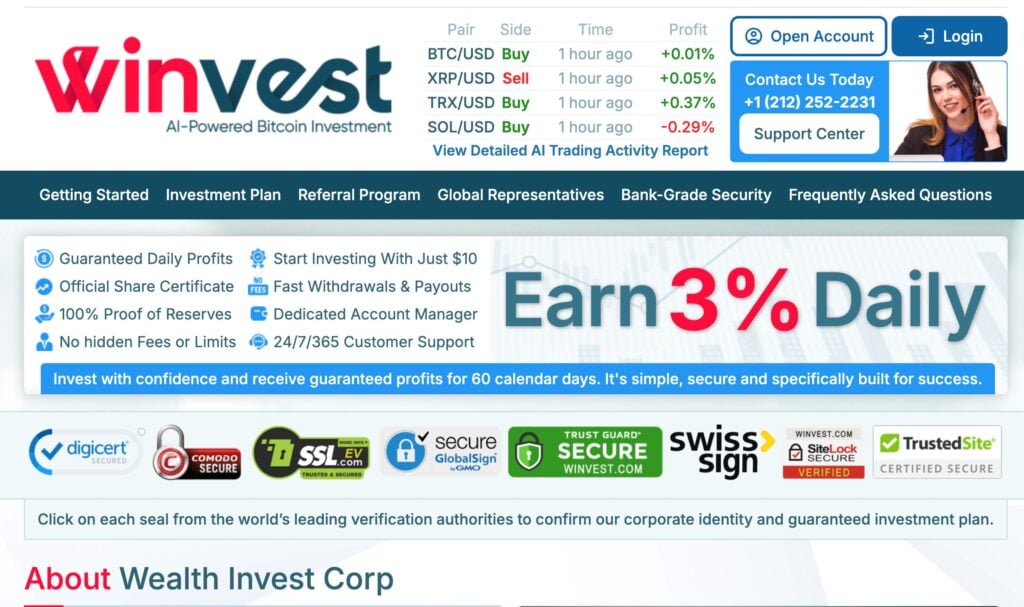
It is also described as an exclusive opportunity available only until a certain capital target is reached, after which it is said to be closed for new participants. The minimum investment requirement is $10, making it accessible to many users.
In addition, the platform claims that investors receive a legal share certificate as proof of investment. It also states that earnings can be withdrawn daily in Bitcoin without hidden fees, withdrawal limits, taxes, or additional charges.
While these features may appear attractive, the combination of fixed daily returns and guaranteed withdrawal conditions is highly unusual in real financial systems. In genuine markets, returns fluctuate based on performance, and no system can reliably guarantee fixed daily profits regardless of market conditions.
Concerns Around 3% Daily Returns:-
One of the most important concerns is the claim of around 3% daily profit. In real financial markets, such consistent returns are extremely rare and not typically seen in regulated investment environments.
Cryptocurrency markets are highly volatile, and even experienced traders face losses on certain days. Because of this, fixed daily profit promises do not align with real market behavior.
When calculated over time, a 3% daily return results in extremely high compounded growth, which becomes difficult to sustain in real trading conditions. This raises concerns about whether such returns can be generated consistently through market based activity alone.
Simple Logic Behind The Business Model:-
There is also a logical question that arises here. If a platform truly had a system capable of generating 3% profit every single day, then it would not need to rely on public investors at all.
In real world finance, highly profitable companies or trading firms usually:
- Use their own capital or institutional funding.
- Borrow from banks at relatively low interest rates.
- Operate privately without needing mass investor recruitment.
In real financial systems, profitable firms usually rely on institutional funding, internal capital, or low interest borrowing rather than mass investor recruitment. The need to continuously collect funds from new investors raises questions about how the returns are actually being generated and sustained.
Referral System And Pyramid Like Structure:-
Another important aspect of the Winvest model is its referral program. Users are reportedly rewarded for bringing in new investors, and commissions are extended up to a 3-level downline, meaning a user can earn not only from direct referrals but also from the investments made by people recruited by their referrals.
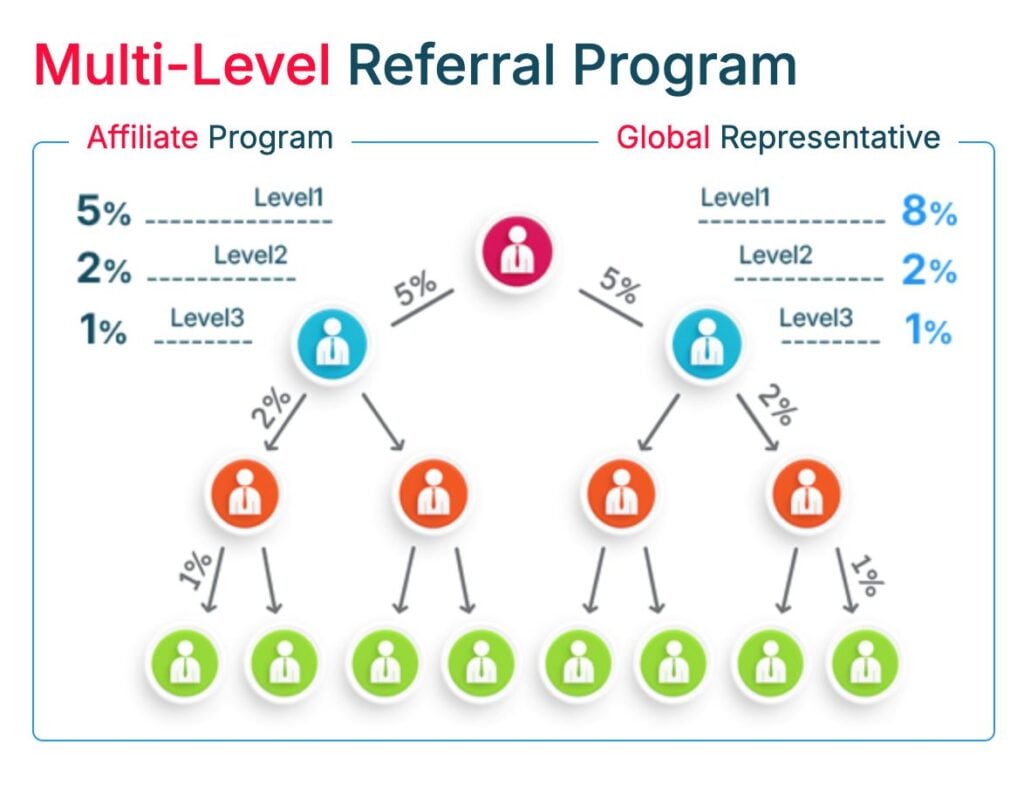
This means earnings are not only linked to investment performance but also to how actively a user expands their network. Participants are encouraged to build multiple layers of referrals, creating a structured network-based earning system.
This type of arrangement shares similarities with pyramid-style systems, where income flows upward from new participants to earlier participants across multiple levels. In such systems, growth depends heavily on continuous recruitment rather than independent revenue generation. When recruitment slows down, the inflow of new funds may also decrease, which puts pressure on payout stability.
HYIP Like Business Characteristics:-
The overall structure also resembles what is commonly known as a High-Yield Investment Program (HYIP). These systems typically offer unusually high fixed returns, often daily or weekly, while depending heavily on new investor deposits.
HYIP style platforms often operate in cycles where funds from new participants are used to pay returns to earlier participants. This creates an appearance of consistent profitability even if there is no stable underlying business generating real revenue.
Such platforms also commonly use technical terms like AI trading, automated profit systems, and advanced algorithms to increase credibility, even when independently verified trading data is not available.
Sustainability Challenges Over Time:-
A major structural issue in such models is sustainability. When a platform promises fixed returns like 3% daily, it creates a constant financial obligation that must be met regardless of market conditions.
Over time, this leads to increasing pressure on the system because:
- Existing investors expect regular payouts.
- New investments must continuously cover outgoing payments.
- Operational costs and commissions also require funding.
Eventually, the system depends heavily on constant growth. If new investments slow down, financial imbalance can occur because incoming funds may not be enough to support outgoing obligations. This is one of the core weaknesses of high fixed return structures.
Marketing Language Vs Real Proof:-
Winvest also uses strong marketing phrases such as: AI-powered trading engine, fully automated profits, and institutional grade financial technology. While these terms sound advanced, they do not automatically guarantee real performance.
A major concern is the lack of independently verified trading data or audited financial reports that clearly show how profits are generated. In legitimate investment environments, transparency is usually supported by third-party audits, regulatory documentation, and verifiable financial statements.
Without such evidence, investors are left relying mainly on promotional claims rather than confirmed performance data.
Regulatory Considerations:-
The platform mentions compliance and a U.S. based corporate structure. However, it is important to understand that company registration alone does not mean a platform is authorized to offer investment services or guarantee returns.
Proper financial platforms are usually regulated by official authorities such as the U.S. Securities and Exchange Commission, which oversees investment activities and protects investors.
If a platform is offering investment services, its regulatory status should always be independently verified rather than assumed based on marketing statements.
Risk Perspective And Final Analysis:-
From a financial perspective, platforms that combine high fixed daily returns with multi-level referral systems and limited transparency carry significant risk factors. Even if such systems operate for some time, their structure often depends heavily on continuous inflow of new investor funds.
This creates a situation where stability is directly linked to constant expansion. If growth slows down or market confidence drops, the system can face serious operational challenges.
There is also a potential risk of future regulatory scrutiny depending on how funds are managed and how returns are distributed.
Final Verdict:-
Winvest.com shows several characteristics commonly associated with high risk investment structures. These include fixed high daily returns, multi-level referral commissions, and dependence on continuous new investor participation.
From a risk analysis point of view, such models should be approached with extreme caution. Even if they function temporarily, systems that rely heavily on constant expansion often face sustainability challenges over time, which can result in financial losses for many participants.
For anyone considering involvement, it is strongly recommended to carefully verify regulatory status, understand the risk structure, and avoid investing funds that cannot be safely risked in high volatility environments.

De Roka (Suman Roka) is an online scam researcher and consumer protection advocate who has been investigating internet fraud since 2014. He is the founder of De-Reviews.com and former owner of NewsOnlineIncome.com, and works as an Anti-Scam Consultant with the Global Anti-Scam Alliance (GASA.org) and as a content partner with ScamAdviser.
His work focuses on exposing online scams and helping users stay safe from fraudulent websites and schemes. After personally experiencing online scams, he began researching suspicious platforms and sharing findings to protect others.
Today, De-Reviews.com operates as a team of researchers and editors dedicated to identifying scam patterns and educating the public about online threats. Learn more about the team and mission on our About Us page.


Leave a Reply