
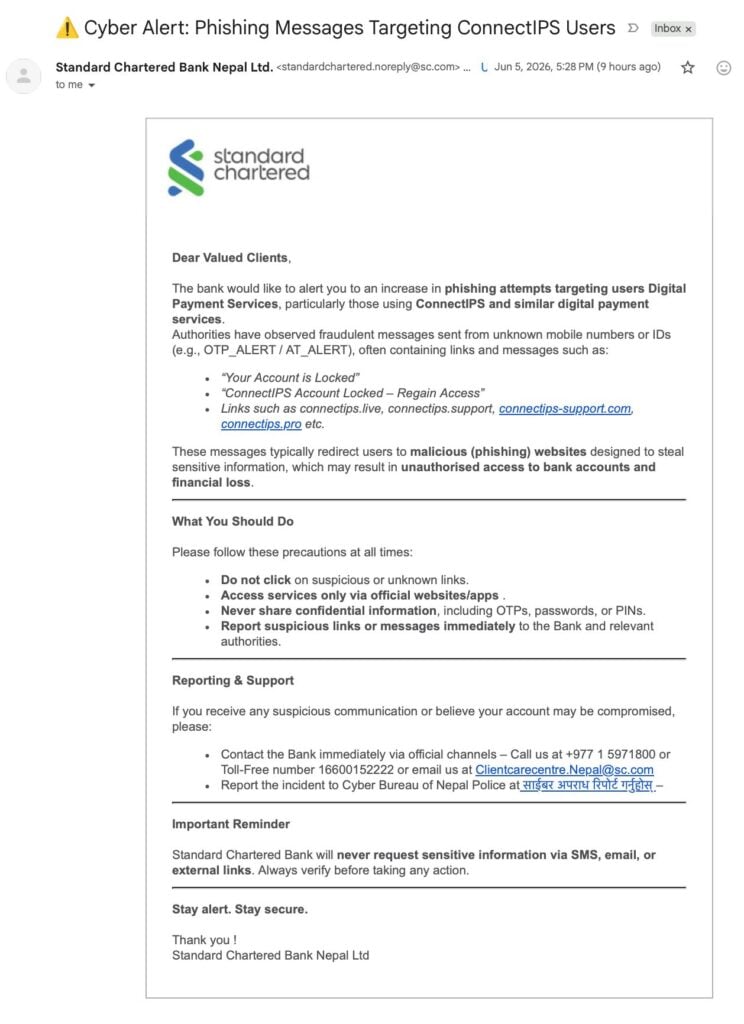
Recently, Standard Chartered Bank Nepal Ltd has issued an important warning to its customers about a growing wave of phishing scams targeting users of digital payment services in Nepal, especially those using ConnectIPS.
Here, we are breaking this alert down in a simple way so everyone can understand what is happening, how the scam works, and how to stay safe.
What Is Happening In This Scam:-
Cyber criminals are sending fake SMS messages and alerts pretending to be from banks or payment service providers. These messages are being sent from unknown numbers or suspicious sender IDs such as:
- OTP_ALERT;
- AT_ALERT.
The messages are designed to create panic and urgency. They usually contain alarming statements like:
- Your Account is Locked.
- ConnectIPS Account Locked, Regain Access Immediately.
- Security Alert: Verify Your Account Now.
Along with these messages, users are asked to click on links that look very similar to official services. Some of the fake domains being used include:
- connectips.live;
- connectips.support;
- connectips-support.com;
- connectips.pro.
Initially, these websites may look real, but they are not connected to any official banking system. Their only purpose is to steal personal and financial information.
Official Warning From The Bank:-
Standard Chartered Bank Nepal Ltd has clearly stated that:
- The bank does not request sensitive details through SMS or email.
- Users should never click unknown links.
- Customers must only use official apps or verified websites.
- Any suspicious activity should be reported immediately.
The bank also reminded users to stay alert and always verify before taking any action.
How The Phishing Attack Works Step By Step:-
This scam is not random. It is carefully planned to trick users into giving away sensitive data.
Fake urgency message:-
The scam starts with a message that creates fear. For example, it says your account is locked or suspended. This makes users panic and react quickly without thinking.
Fake link click:-
The message includes a link that looks official. When users click on it, they are redirected to a fake website that is designed to look like the real ConnectIPS login page.
Fake login page:-
The website asks users to enter sensitive details such as:
- Username and password.
- OTP (One Time Password).
- PIN or banking credentials.
The page may even look professional, making it hard to identify it as fake.
Data theft:-
Once the user enters their details, scammers immediately capture the information. This allows them to gain unauthorized access to the victim’s bank account or digital wallet.
Financial loss:-
In many cases, attackers can transfer money, make unauthorized transactions, or misuse the account before the user even realizes what has happened.
Why This Scam Is So Dangerous:-
This type of phishing attack is becoming more common not only in Nepal but globally because it is simple, cheap, and effective for criminals. It works mainly because:
- It uses fear based messaging like “account locked”
- It copies real banking website designs.
- It targets widely used services like ConnectIPS.
- It tricks users into giving OTPs and passwords directly.
The most dangerous part is that users often believe these messages are real because they look similar to official bank alerts. Even one mistake, such as entering your OTP on a fake website, can lead to full account compromise.
What You Should Do To Stay Safe:-
Here are simple but very important safety steps every user should follow:
- Never click on unknown or suspicious links.
- Always access banking services through official apps or websites only.
- Do not share OTP, PIN, password, or any banking details.
- Ignore messages that create urgency or fear.
- Double check any message by contacting your bank directly.
- Keep your phone and apps updated for better security.
Remember, real banks will never ask you to verify sensitive information through random links or SMS messages.
What To Do If You Already Received Such Messages:-
If you have received a suspicious SMS or accidentally clicked on a fake link, you should act immediately:
- Contact your bank using official support channels.
- Monitor your bank account for any unusual activity.
- Change your passwords if you entered them on a suspicious site.
- Report the incident to cyber authorities as soon as possible. You can officially report cybercrime incidents in Nepal here: Report Cyber Crime Nepal Police
Bottom Line:-
Phishing scams targeting digital payment users are increasing rapidly in Nepal, and scammers are becoming more advanced in how they design fake messages and websites. They are no longer using obvious tricks, instead, they are copying real systems and creating believable alerts.
However, the key defense is still awareness. If you remember one thing from this article, let it be this: never trust urgent messages asking for banking details, and never click unknown links.
Stay alert, stay informed, and always verify before you act.

De Roka (Suman Roka) is an online scam researcher and consumer protection advocate who has been investigating internet fraud since 2014. He is the founder of De-Reviews.com and former owner of NewsOnlineIncome.com, and works as an Anti-Scam Consultant with the Global Anti-Scam Alliance (GASA.org) and as a content partner with ScamAdviser.
His work focuses on exposing online scams and helping users stay safe from fraudulent websites and schemes. After personally experiencing online scams, he began researching suspicious platforms and sharing findings to protect others.
Today, De-Reviews.com operates as a team of researchers and editors dedicated to identifying scam patterns and educating the public about online threats. Learn more about the team and mission on our About Us page.


Leave a Reply